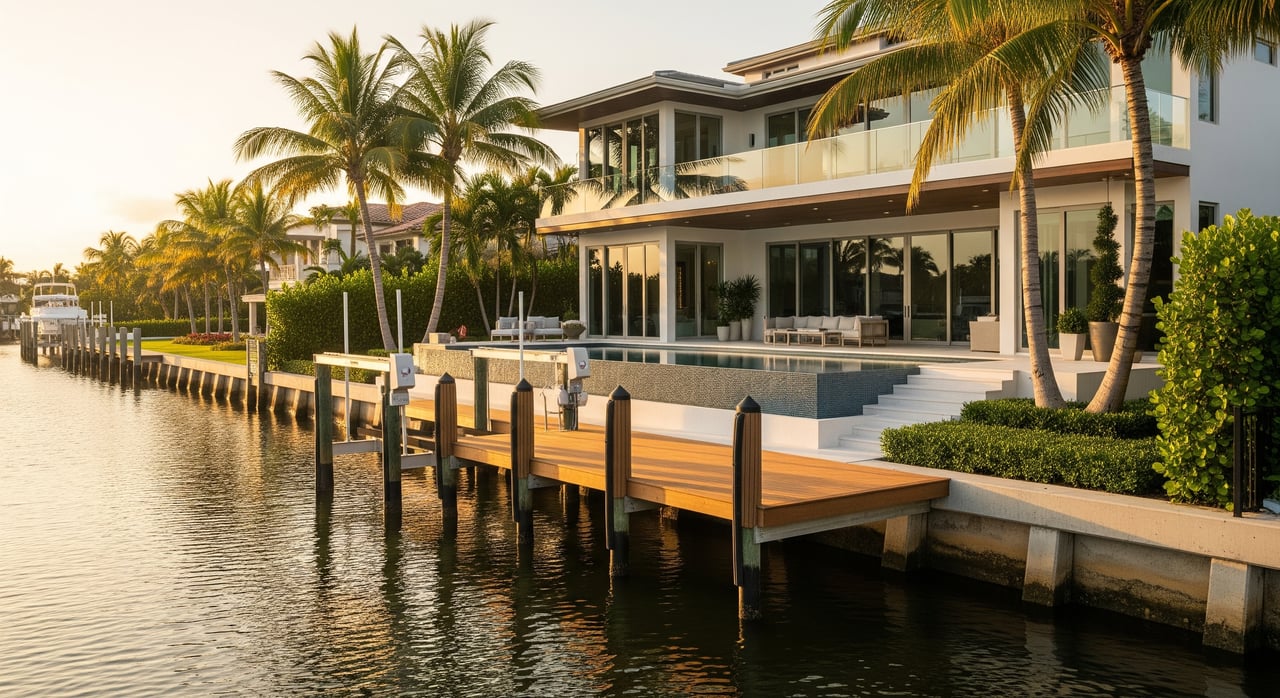
Shopping waterfront in Fort Lauderdale is exciting, but the jargon can get in the way fast. You might hear terms like ICW, MLW, bascule bridge, or riparian rights and wonder what they actually mean for your boat and daily life. You want a property that fits your vessel, your routines, and your long-term plans without surprise costs.
This guide breaks down the key waterfront terms and how they play out across Fort Lauderdale’s oceanfront, Intracoastal, canal systems, and marinas. You will learn how to match a property to your boat, what to check before you write an offer, and which agencies oversee docks, seawalls, and permits. Let’s dive in.
Fort Lauderdale waterfront types
Fort Lauderdale offers four primary waterfront experiences. Each has different boating routes, upkeep responsibilities, and lifestyle tradeoffs.
| Type | What it is | Boating reality | Lifestyle notes |
|---|---|---|---|
| Oceanfront | Direct frontage on the Atlantic along the barrier island | Blue-water access after transiting to an inlet such as Port Everglades. Larger yachts usually rely on marinas rather than docking directly on the oceanfront. | Iconic views and beach access with higher exposure to ocean weather. Limited private dock options since submerged lands seaward of the mean high water line are typically state-controlled. |
| Intracoastal Waterway (ICW) | Protected channel between the barrier island and mainland | Sheltered cruising with access to inlets, marinas, and services. Expect a mix of fixed and movable bridges. | Many homes have private docks. Wakes and traffic can be noticeable. Bridge clearance can limit tall vessels. |
| Canal-front | Residential canals connecting to the ICW or interior waterways | Canal width, depth, and turning room set real limits on boat size and maneuvering. Conditions vary by location. | Quieter setting and more privacy. Docks and lifts are common. Rules differ by city and HOA. |
| Marina or slip | Commercial or community dockage, wet or dry | Predictable power, fuel, haul-out, and services. Good for larger vessels or owners who prefer turnkey operations. | Less private control and added fees, but minimal personal maintenance on seawalls or docks. |
If you picture calm morning coffee with your boat on a lift, a canal-front home may be ideal. If you want easy cruising to restaurants and marinas, ICW frontage shines. If your priority is direct beach access and views, oceanfront is unmatched, with the understanding that docking is not the main feature. If you own a large yacht or value services over self-maintenance, a marina slip can be the most practical choice.
Boat-fit terms that matter
Before you fall in love with a view, make sure the route and dock can handle your boat. These core terms determine compatibility.
Draft
- Definition: The vertical distance from the waterline to the lowest point of your boat.
- Why it matters: You need enough water at the lowest normal tide to avoid grounding. Ask for depth measurements referenced to mean low water, not just a high-tide reading.
Air draft and bridge clearance
- Definition: Air draft is the height of your boat from waterline to the tallest fixed point. Bridge clearance is the vertical space under a bridge when closed.
- Why it matters: Fixed bridges set hard limits. Movable bridges open, but they follow operating rules. Tall sportfishing boats and sail rigs require careful route planning.
LOA and beam
- Definition: LOA is length overall. Beam is the boat’s widest width.
- Why it matters: Your dock or slip must fit LOA and beam with extra space for lines and fenders. Canal width and turning basins also need to accommodate your maneuvering.
Channels and aids to navigation
- Definition: Channels are dredged or naturally deep routes marked by buoys and markers.
- Why it matters: Staying in marked channels reduces risk of shoaling. Local charts and navigation notices help you plan safe approaches to your dock.
MLW and MHW
- Definition: Mean low water and mean high water are tidal datums used for depth and shoreline references.
- Why it matters: Depth at mean low water is the conservative number to compare against your draft. Submerged land boundaries and some property references also use these datums.
Seawall, bulkhead, and riprap
- Definition: A seawall or bulkhead is a retaining wall along the shoreline. Riprap is rock armor that protects the bank.
- Why it matters: Seawall condition affects stability, dock support, and insurance. Repairs or full replacement can be costly, so inspection is important.
Riparian and littoral rights
- Definition: Waterfront owners generally have rights of access and reasonable use of adjacent waters. Sovereign submerged lands are often held by the state.
- Why it matters: You may have the right to install reasonable docking facilities, but you often do not own the bottom. Docks, seawalls, lifts, or dredging typically require permits from local and state agencies.
Fixed vs movable bridges
- Definition: Fixed bridges do not open. Movable bridges, including bascule or drawbridges, open to allow taller boats through.
- Why it matters: Your route may be limited by a fixed bridge or delayed by movable bridge schedules. Plan for operating hours and any restrictions.
No-wake and speed zones
- Definition: Areas where boats must travel at slow speed to reduce wake and protect safety.
- Why it matters: Many residential waterways in Fort Lauderdale have speed controls. Expect enforcement for safety and to protect docks and shorelines.
Dock types and lifts
- Definition: Common setups include wet slips, dry stack storage, piling docks, T-docks, finger piers, and davits or boat lifts.
- Why it matters: A lift keeps your hull out of the water and reduces fouling, but it requires power, structural support, and appropriate permits. Finger piers and T-docks change how you load, tie off, and step aboard.
Permits, seawalls, and who regulates what
Several agencies oversee the waterways and waterfront construction in and around Fort Lauderdale. Understanding who does what will help you plan improvements and avoid compliance issues.
- City of Fort Lauderdale: Local permits for docks, pilings, boat lifts, and some waterway management. Many projects need city approval and inspections.
- Broward County: Environmental services, shoreline projects, and some dredging programs occur at the county level.
- Florida Department of Environmental Protection: Oversees sovereignty submerged lands and issues permits for docks, seawalls, and dredging in tidal waters.
- U.S. Army Corps of Engineers: Federal permits may be required for dredging and certain work in navigable waters.
- U.S. Coast Guard: Publishes bridge operation regulations and navigation notices. Also oversees navigation safety.
- Florida Fish and Wildlife Conservation Commission: Enforces boating laws, including speed and no-wake rules.
- FEMA Flood Maps: Define flood zones and can trigger elevation and insurance requirements.
Typical responsibilities and costs to keep in mind:
- Docks and lifts: Most construction or modification needs permits. Always ask for permit records and final approvals.
- Seawalls: Replacement or major repair is usually permitted and can be costly. In some areas there are programs or shared responsibilities, but assume the owner is responsible unless documents say otherwise.
- Dredging: Deepening a private approach often requires county, state, and federal permits. Costs can be significant, and approvals can take time.
- Maintenance liability: Owners typically maintain private docks and seawalls along their property. In associations, review governing documents to see who pays for common structures or channels.
- Inlets and port areas: Port Everglades and its inlet are regulated. Expect large commercial traffic, security zones, and marked deep channels near the port.
Buyer checklist and verification steps
Bring this list to showings and use it before you draft an offer.
Pre-offer questions
- What type of waterfront is it: oceanfront, ICW, or canal? Where do the property’s rights terminate relative to the waterline?
- Is the dock, lift, or seawall permitted? Ask for permit numbers, as-built drawings, and dates of last permits.
- What is the water depth at the dock and at the canal entrance, referenced to mean low water?
- Are there HOA, city, or county rules on dock size, lifts, live-aboard use, or slip rental?
- What repairs have been done on the seawall or dock, and is there a maintenance or inspection history?
- What bridges are on the route to open water, and what are their types and clearances?
- Are there recorded easements, submerged land leases, or agreements that affect dock use?
- What is the flood zone, and is there a recent elevation certificate?
Documents to request
- Dock, lift, and seawall permits with final approvals and as-built drawings.
- The current survey showing mean high or low water lines and any easements.
- A recent seawall inspection or engineer’s assessment if available.
- Dredging or channel maintenance records for private canals.
- HOA covenants and rules for boat size, dock use, and lift limitations.
- FEMA elevation certificate and any flood insurance claims history for the property.
Inspections and specialists
- Licensed marine contractor or structural engineer to evaluate the dock, pilings, and seawall.
- Licensed surveyor to confirm boundaries, encroachments, and easements near the waterline.
- Marine surveyor to check your boat’s fit to the slip or lift and to estimate clearances.
- Title search focused on riparian rights, easements, and any liens on docks or submerged lands.
- Local marina or boatyard consultation for typical slip availability for your LOA, beam, and draft.
How to verify depth and clearances
- Request depth measurements at mean low water and confirm when the measurements were taken.
- Review official charts and navigation notices for channels, marked routes, and shoaling advisories.
- Confirm fixed bridge clearances and movable bridge operating regulations from published tables. Measure your air draft and compare.
- For private or unmarked canals, consider a recent sounding or have a diver or contractor confirm bottom depth and obstructions.
What this means for your search
Your perfect Fort Lauderdale waterfront match depends on three constraints that work together: depth for your draft, dock or slip size for your LOA and beam, and bridge clearance for your air draft. Once those are aligned, weigh the lifestyle tradeoffs. The ICW offers convenience and activity. Canals offer privacy and a neighborhood feel. Oceanfront adds drama and beach access with more exposure to the elements. Marinas deliver services with fewer maintenance duties at home.
A careful review of permits, seawall condition, and route feasibility will protect your investment. With the right plan, you can enjoy sunrise cruises, easy access to the inlet, and the peace of mind that your dock and boat fit today and in the years ahead.
If you want tailored guidance on matching your boat and lifestyle to the right Fort Lauderdale property, reach out. You will get white-glove representation with a design-forward eye for value and the local expertise to simplify every step. Connect with Amie Balchunas to schedule a free consultation.
FAQs
What determines the largest boat I can keep at a Fort Lauderdale home?
- Three limits work together: depth at mean low water for your draft, dock or slip length and width for your LOA and beam, and air draft versus any fixed bridge on your route.
Do I own the ocean bottom in front of an oceanfront property?
- Typically no. The state commonly holds sovereignty over submerged lands. You have rights of access and reasonable use, but docks and similar structures require permits.
Who is responsible for seawall and dock repairs at a private home?
- Usually the property owner, unless an HOA or recorded agreement states otherwise. Confirm through a title search and association documents.
Are there special storm or hurricane considerations for waterfront homes?
- Yes. Expect coastal building codes, flood insurance requirements in certain zones, and the need for a hurricane plan for your boat. Many marinas offer haul-out or storm plans.
Do Fort Lauderdale canals get dredged on a schedule?
- Public channels are dredged as needed through county or city programs. Many private canals are not dredged unless a community agreement funds it, subject to permits.
How do movable bridges affect my boating routine?
- Movable bridges generally open on signal or schedule, and fixed bridges do not open. Check published operating rules and plan for possible wait times.
What hidden costs come with a private dock?
- Common expenses include seawall repair or replacement, dock structural work, electrical and water upgrades, boat lift service, dredging, and piling replacement, along with insurance.